Disney’s Kimmel Suspension Highlights Trump’s Growing Influence Over Media
Trump Media Influence: The most recent example of President Donald Trump’s ability to manipulate media, entertainment, and digital platforms to his will is the abrupt suspension of talk show host Jimmy Kimmel by ABC, which opens a new tab after facing pressure from the Federal Communications Commission. Trump also uses political pressure to silence critics and penalize organizations he believes to be biased against him.
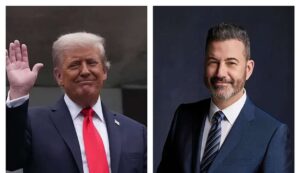
Kimmel’s comments regarding the alleged murderer of conservative activist Charlie Kirk sparked the action, which shocked the American media and entertainment sectors and heightened concerns about free speech as Trump-appointed FCC chair Brendan Carr threatened to cancel broadcast licenses from stations that air what he called “garbage.”
Whether they lined up behind Trump at his inauguration, gave to his inaugural fund, or visited the White House with presents, Trump fans or rich business executives now run major media and digital firms. As part of a group of investors, billionaire Republican contributor Larry Ellison’s Oracle opens a new tab with the inside track to acquire control of the video-sharing site TikTok’s U.S. operations.
A framework for an agreement with China that would let the sale of TikTok’s U.S. assets to continue operating in the U.S. was approved by the Trump administration this week.
In the wake of Trump’s reelection, organizations including CBS, Meta Platforms (META.O) opened a new tab, and the editorial pages of the Washington Post and the Los Angeles Times made operational or editorial modifications that set the stage for less critical coverage of the president.
Victor Pickard, a professor of media strategy and political economics at the University of Pennsylvania’s Annenberg School of Communication, said that “there is a continued lurch to the right throughout much of our major media in the United States right now.” “I anticipate seeing more of this in the future. It is not opposed by any opposing power.
The choice Walt Disney (DIS.N), the parent company of ABC, has responded to remarks made on-air for the second time since Trump’s reelection on Wednesday night. In order to resolve a lawsuit that Trump had filed over comments made by anchor George Stephanopoulos about sex assault allegations made against him by author E. Jean Carroll, ABC News agreed to pay $15 million to Trump’s presidential library in December.
According to Steve Kroft, a former “60 Minutes” journalist, “they’re all terrified,” referring especially to the news presentation that airs every night. “This administration’s retaliatory worldview, which targets its adversaries, is what most worries me. Additionally, I believe they are obviously targeting the press media. At the top of their list is that.
Disney chose not to respond.
White House spokesperson Abigail Jackson said, “A private company is under no obligation to lose money producing an unpopular show, but Jimmy Kimmel is free to make whatever bad jokes he wants.” “Jimmy Kimmel’s terrible product isn’t a free speech problem; it’s a talent problem.”
ACTION TO END PERCEIVED BIAS
Following conservatives’ successful drive for internet platforms to reduce content filtering, which they characterized as biased, pressure has been placed on traditional media.
After Trump was banned from Twitter for “incitement of violence” during the riot at the U.S. Capitol on January 6, 2021, Elon Musk pledged to reinstate “free speech” on the site when he bought it in 2022. Musk rebranded the company as X, removed its Trust and Safety staff in favor of a feature that lets people verify content, and reinstated conservative users’ accounts that had previously broken Twitter’s rules.
According to a Queensland University study, the platform’s content has shifted to the right following the takeover.
Facebook, Instagram, and Threads were all impacted when Meta Platforms terminated its third-party fact-checking initiative in the US.
The corporation promoted well-known Republican policy leader Joel Kaplan to oversee global affairs and appointed Trump friend and Ultimate Fighting Championship CEO Dana White to its board.
“There are just too many errors and too much censoring at this stage. In January, CEO Mark Zuckerberg said that it was time to return to our foundation in the area of free speech.
The FCC’s authority over media mergers
In addition to broadcast licenses, the FCC must approve media acquisitions involving regional broadcasters. With the assurance that the CBS network will represent the “varied ideological perspectives” of American viewers, David Ellison, the son of longstanding Trump supporter Larry Ellison, helped get regulatory clearance for his business Skydance Media to purchase Paramount (PSKY.O). A new tab is opened.
A 2024 lawsuit that Trump brought over a “60 Minutes” interview with former Vice President Kamala Harris, which he said presented a skewed picture of his presidential opponent, was settled by Paramount for $16 million before the transaction.
According to the FCC, there was no connection between the settlement and the regulatory investigation.
Kenneth R. Weinstein, a former president and CEO of the conservative Hudson Institute, was named the company’s new ombudsman last week.
According to reports, Paramount is in negotiations to buy The Free Press and promote its creator, Bari Weiss, to a senior position at CBS News. By opposing what she sees as “wokism” and the illiberal left, the former New York Times editorial columnist gained a national following.
While Larry Ellison’s cloud company Oracle is in the running to purchase TikTok, which would give a conservative billionaire control over a crucial communication tool that reaches 170 million Americans, Paramount is now contemplating a bid to acquire Warner Bros. Discovery (WBD.O), which opens a new tab and is home to CNN.
A representative for parent company Paramount referred Reuters to CEO David Ellison’s earlier remarks on the network’s political impartiality when questioned about claims of a right-leaning shift at CBS. “We’re an entertainment company first,” Ellison has said. “Its audience is everyone, young and old, left and right. I’m not going to be in a position to say anything that’s political.”
“THE HARD OR THE EASY WAY”
When Carr of the FCC stepped up the ante, Disney was trying to figure out how to calm the social media uproar over Kimmel’s remarks.
The FCC threatened to revoke the broadcast licenses of local television stations that failed to comply, claiming that Kimmel deceived viewers about the suspected shooter’s ties to Trump’s Make America Great Again campaign and pushed local stations to resist.
Carr said in an interview with conservative podcaster Benny Johnson on Wednesday that “we can do this the easy way or the hard way.”
After Kimmel’s remarks against Kirk prompted Nexstar Media Group (NXST.O), the biggest broadcast station owner in the United States, to decide to preempt the program, ABC yanked him off the air. Sinclair, the biggest owner of TV stations connected to ABC in the country, did the same.
During Kimmel’s usual time slot on Friday, a Charlie Kirk special was shown by a number of ABC stations.
To surpass the FCC’s regulatory limit on station ownership and complete its previously announced $6.2 billion purchase of Tegna, the owner of 64 television stations, Nexstar will need the agency’s permission.
“The senior executive team at Nexstar unilaterally decided to preempt ‘Jimmy Kimmel Live!'” said Gary Weitman, chief communications officer for the firm. “And before making that decision, they had no communication with the FCC or any other government agency.”
PROTECTION OF THE PRESS
Due to negative coverage, Trump has attacked major media outlets in court. Since 2020, he has brought nine legal cases involving the media, including a $15 billion defamation case against the New York Times, a $10 billion lawsuit against the Wall Street Journal in July, and a new tab and book publisher, Penguin Random House, filed this week.
According to the Journal, the complaint has no merit. According to The Times, Trump’s lawsuit is an effort to suppress and dissuade independent reporting and has no valid legal arguments.
Trump was given 28 days to submit an updated complaint after a federal court dismissed the Times lawsuit on Friday due to its content, opening a new tab. The judge said that a complaint is neither “a protected platform to rage against an adversary” nor “a public forum for vituperation and invective.”
When considered together, the actions are seen by First Amendment experts as a comprehensive effort to stifle free expression in the United States. In a statement, Jameel Jaffer, executive director of Columbia University’s Knight First Amendment Institute, stated, “The Trump administration is becoming more blatant in its abuse of government power to silence its critics.”
Conservatives have voiced concerns about the use of government authority to censor speech, even as some have singled out Kirk detractors.
According to David Inserra, a fellow for free expression and technology at the Cato Institute, “conservatives rightfully complained when the government targeted their speech during the Biden administration.” “However, the Trump administration is now defending censorship with many of the same justifications.”