Supreme Court to Decide Fate of Key Parts of Trump’s Economic Agenda
Trump’s economic agenda Supreme Court: President Donald Trump’s global tariffs and his bid to oust Federal Reserve Governor Lisa Cook, unprecedented assertions of executive power that underlie his economic policy, are now in the hands of the U.S. Supreme Court, which will decide how far he can go to reshape and control the levers of the economy.
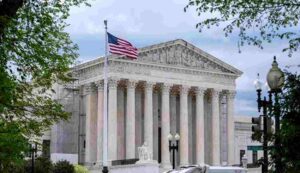
Two high-stakes cases with significant ramifications for the court and the Republican president are before the highest U.S. judicial body in less than a week.
In an unprecedented action since the central bank’s establishment in 1913, Trump’s administration filed a plea on Thursday, opening a new tab, requesting the court to overturn a federal judge’s injunction that prevented him from firing Cook. Cook was appointed by Joe Biden, Trump’s Democratic predecessor.
On September 9, the court agreed to use a rule that grants a president the ability to address “an unusual and extraordinary threat” during a national emergency to determine whether Trump had overreached himself in enforcing the majority of his broad import tariffs.
The International Emergency Economic Powers Act, or IEEPA, was passed in 1977 and has traditionally been used to freeze the assets of adversaries or impose penalties on them. It had never been used to levy tariffs until Trump.
“We have seen Supreme Court rulings and directives that increase the executive branch’s authority since President Trump assumed office for a second term. “The Supreme Court is being asked to go much further in the tariffs case and the Federal Reserve case,” said Sarah Konsky, director of the Supreme Court and Appellate Clinic at the University of Chicago Law School.
“If the Supreme Court agrees with President Trump’s position in either or both of these cases, that would be an even more dramatic expansion of executive power,” Konsky said.
The court begins its second nine-month term on October 6 and has a conservative majority of 6-3, including three judges Trump nominated during his first year in office. Depending on what it does, it might respond to the Justice Department’s request about Cook in a matter of days or weeks. The tariffs issue has been expedited by the court, which said Thursday that it would hear arguments on November 5.
LEGAL DELINEATIONS
With possibly hundreds of billions of dollars in import tariffs and the central bank’s independence at stake, the court’s decisions in these cases have significant ramifications for the country’s economy and monetary policy.
Since taking office again in January, Trump has taken a number of unilateral moves to target perceived adversaries, tighten down on immigration, reform the federal government, and terminate diversity programs, all of which have challenged the law.
Trump’s program has been hampered by several judgments from lower courts, and many of his controversial measures have been contested in court. Trump, however, has had success in the Supreme Court, where he has often requested that it step in to resolve these kinds of disputes. In almost every instance it has been asked to consider this year, the court has accepted his administration’s petitions to allow Trump’s policies to continue while legal challenges are being heard.
It remains to be seen whether his economic agenda’s pillars suffer a similar fate. ” He obviously intends to impose broad control in each of these areas. Ilya Somin, a law professor at George Mason University, said, “We’ll see what the court has to say about that.” Somin, a participant in the fight against Trump’s tariffs, went on to say, “He is laying claim to sweeping executive powers that it would be dangerous for any one man to have.”
It would “undermine the rule of law and stable expectations that are necessary for an effective economic system to function,” Somin said, if the president were given such authority. Trump’s effort to remove Cook is based on his assertions that she committed mortgage fraud before assuming office, which she rejects. The first Black woman to hold the position of Fed governor, Cook, has said that the accusations were a ruse to dismiss her due to her views on monetary policy and that the president does not have the legal right to fire her.
The 1913 statute that established the Fed included clauses designed to protect the central bank from political meddling. That statute states that a president may only dismiss Fed governors “for cause,” but it doesn’t specify what that means or how it’s done. The legislation has never been put to the test in court, and no president has ever dismissed a Fed governor.
Trump’s Agenda for Tariffs
In order to resolve trade imbalances, Trump used the IEEPA to impose tariffs on commodities imported from certain nations in April. Separate duties were also proposed in February as economic pressure on China, Canada, and Mexico to stop the trafficking of illegal narcotics and fentanyl into the United States.
Trump’s global trade war has strained relations with trading partners, raised financial market volatility, and exacerbated economic uncertainty worldwide. Trump has renegotiated trade agreements, demanded concessions, and applied political pressure on foreign nations by using the levies.
The president has the authority to set U.S. economic policy, according to Robert Luther III, a law professor at George Mason University. He also said that he expects the Supreme Court will support Trump on tariffs and in dismissing Cook. “President Trump has said unequivocally that the core of his economic strategy is his tariff policy. If the Supreme Court removes one pillar out of that base, the edifice will fall,” Luther added.